


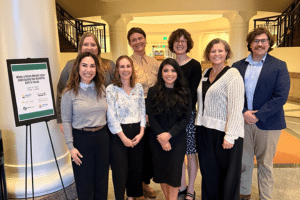
Metrocrest Services was proud to participate in a legislative briefing at the Texas Capitol focused on an issue that quietly affects thousands of working families: the benefits cliff.
Metrocrest Services’ Director of Advocacy and Community Outreach, Jo Collier, and Director of Nutrition Services, Casen McMahan, joined legislators, legislative staff, advocates, employers, and policy experts from across the state for a solution‑oriented discussion about how public benefits can better support families as they work toward stability. For many attendees, this was their first introduction to the concept.
“The benefits cliff occurs when a small increase in income, such as a raise or additional work hours, causes a family to suddenly lose critical supports, such as food assistance, health coverage, or child care assistance,” shared Collier. “Instead of moving forward, families can find themselves financially worse off for earning more. A modest raise may result in hundreds of dollars in lost benefits, creating a system that unintentionally discourages progress rather than rewarding it.”
The briefing opened with an economic overview from Dr. Craig Gundersen of Baylor University, who explained how current benefit structures can trap families at certain income levels despite their efforts to advance. He shared data showing how abrupt benefit cutoffs affect household stability and outlined potential ways benefits could phase out more gradually as income increases. His framing helped establish a shared understanding of both the challenge and the opportunity for smarter policy design.
The conversation then shifted to real‑world implications. Freddy Warner of Memorial Hermann spoke about how gaps in health coverage, particularly the lack of Medicaid expansion in Texas, intensify the effects of the benefits cliff. He shared compelling data showing how these coverage gaps impact individuals, families, and the hospital and medical systems that serve them, underscoring how closely economic mobility and health care access are connected.
The human side of the issue was powerfully illustrated by Cristina Guajardo, Board Member for United Way of Greater Austin, who shared her lived experience navigating public benefits while trying to move forward. Her story brought clarity to how confusing and precarious the system can feel for families doing exactly what is expected of them.
Policy solutions were a central focus of the briefing. Elizabeth Colvin, CEO of RAISE Texas, provided context on prior Texas efforts to address the benefits cliff and highlighted examples from states such as Iowa and Florida, along with ACA‑related policies. These models demonstrated that it is possible to gradually reduce benefits as income grows rather than cutting families off all at once, supporting workforce participation while maintaining a meaningful safety net.
The April 23 briefing welcomed 37 total attendees. Throughout the discussion, visible engagement showed the issue resonated, particularly with those encountering it for the first time. While the briefing marked an important milestone, it was the result of months of collaboration. Planning began in July 2025 with outreach to RAISE Texas and expanded in September 2025 through coordination with United Way of Texas. The effort quickly grew to include partners across the state who are eager to explore thoughtful policy solutions. Metrocrest Services is especially encouraged by renewed collaboration with Catholic Charities of Fort Worth, key contributors to the passage of H.R. 1483, the Texas benefits cliff pilot in 2019. Partners in Florida are also prepared to share insights from policies that have successfully replaced abrupt benefit drop‑offs with gradual transitions.
At Metrocrest Services, we see the effects of the benefits cliff every day when families work harder only to face new barriers. Policies should support progress, not penalize it. The April legislative briefing helped build shared understanding, strengthen partnerships, and create momentum toward a more economically advantageous path of public benefits. It was an important step forward, and we look forward to what comes next.
If you are interested in learning more about the benefits cliff or the work Metrocrest Services is doing to advocate for public policy that supports our neighbors, please click here to send an email to Jo Collier, Metrocrest Services’ Director of Advocacy and Community Outreach.





 This institution is an equal opportunity provider.
Leave A Comment